
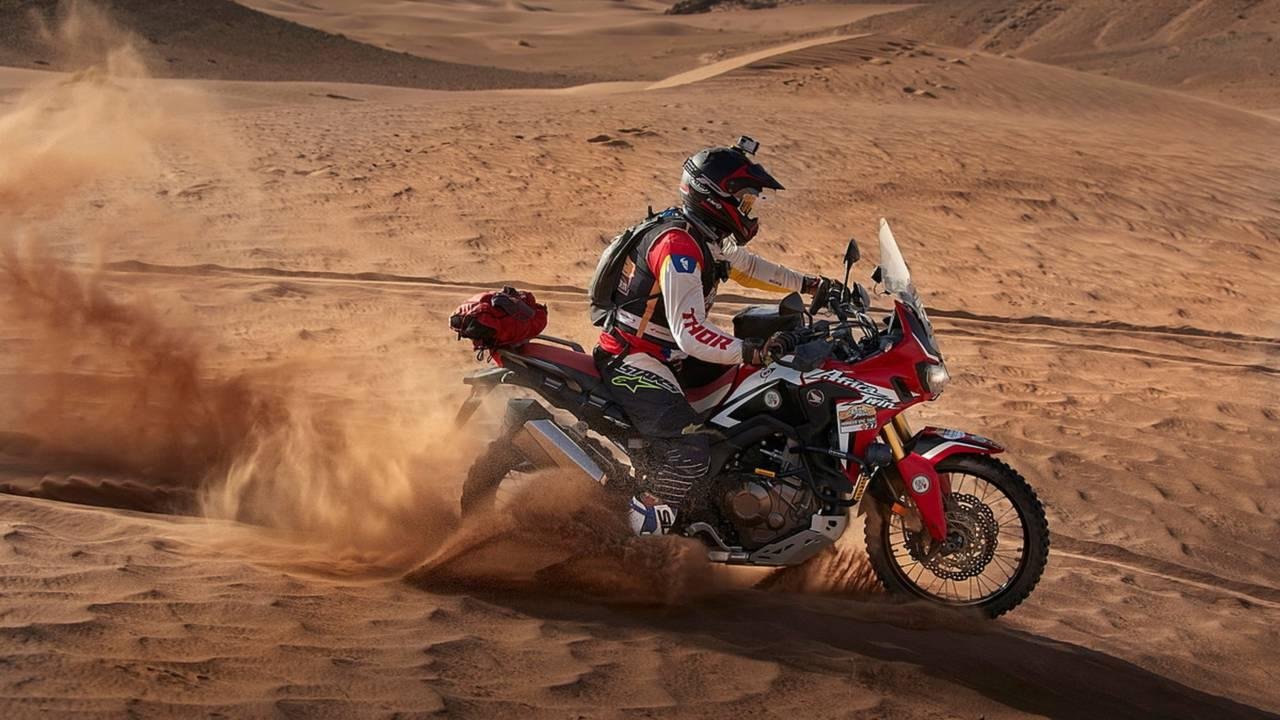
The Honda Africa Twin has become one of the most recognizable adventure motorcycles in the world, but popularity alone does not tell you how a motorcycle performs after years of serious use.
The real test comes from long-distance touring, dirt roads, rough tracks, heat, dust, questionable fuel and thousands of kilometers far from the nearest workshop.
That is where the Africa Twin has built its reputation.
When Honda brought the Africa Twin back in 2016 as the CRF1000L, the adventure-bike market was dominated by powerful and increasingly complicated motorcycles such as the BMW R1200GS and KTM 1190 Adventure. Honda took a different approach.
Instead of chasing maximum horsepower, the Africa Twin focused on usable torque, manageable handling, long-travel suspension, reliability and genuine off-road ability.
After years of touring use, that formula still makes a lot of sense.
In this detailed Honda Africa Twin review, we look at the first-generation 2016–2018 CRF1000L, including its reliability, engine performance, off-road handling, suspension, comfort, known problems and whether buying one used in 2026 is still a good idea.
Honda Africa Twin Review: Quick Verdict

The Honda Africa Twin CRF1000L remains one of the strongest all-round adventure motorcycles of its generation.
Its biggest strengths are not extreme horsepower or sophisticated luxury equipment. Instead, the Africa Twin delivers a combination of:
- Excellent reliability
- Strong low- and mid-range torque
- Genuine off-road capability
- Comfortable long-distance ergonomics
- 21-inch front and 18-inch rear wheels
- Long-travel suspension
- Manageable power delivery
- Good balance for such a large motorcycle
- Straightforward maintenance
- Available manual or DCT transmission
Its main weaknesses are its substantial weight, modest horsepower compared with some rivals, a few known issues on early models and some components that require attention when the motorcycle is regularly ridden off-road.
For riders looking for an adventure motorcycle capable of crossing countries during the week and exploring desert tracks at the weekend, the Africa Twin remains a very convincing package.
Honda Africa Twin CRF1000L Specifications
Honda designed the original CRF1000L around a 998 cc liquid-cooled parallel-twin engine.
One of the most important details is its 270-degree crankshaft, which helps create a power delivery and engine character closer to a V-twin than a traditional parallel twin.
2016–2018 Honda Africa Twin Engine Specs
| Specification | Honda Africa Twin CRF1000L |
|---|---|
| Engine | Liquid-cooled parallel twin |
| Displacement | 998 cc |
| Crankshaft | 270° |
| Valve Train | Unicam, 4 valves per cylinder |
| Bore x Stroke | 92.0 x 75.1 mm |
| Maximum Power | 70 kW / approximately 95 PS |
| Maximum Torque | 98 Nm @ 6,000 rpm |
| Fuel System | PGM-FI fuel injection |
| Transmission | 6-speed manual or DCT |
| Final Drive | O-ring chain |
| Fuel Capacity | 18.8 liters |
Honda deliberately avoided making the CRF1000L an extremely high-output liter bike.
Instead, the engine was tuned for controllable torque, smooth throttle response and usable performance across a broad rpm range.
That decision is one of the reasons the Africa Twin works so well in real-world adventure riding.
Honda Africa Twin Chassis, Suspension and Brakes
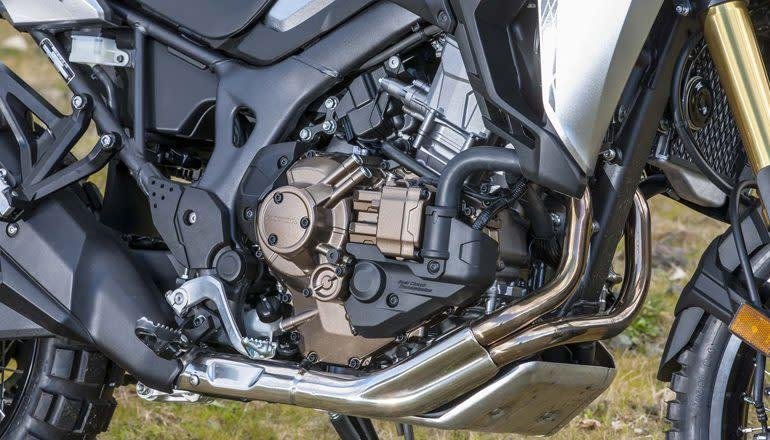

The Africa Twin’s chassis specifications immediately reveal Honda’s intentions.
This was never supposed to be a road motorcycle wearing adventure-style bodywork.
It uses proper off-road wheel sizes and substantial suspension travel.
Chassis Specifications
Front wheel: 21-inch spoked wheel
Rear wheel: 18-inch spoked wheel
Front tire: 90/90-21
Rear tire: 150/70-18
Front suspension: 45 mm Showa inverted fork
Front travel: Approximately 230 mm
Rear suspension: Pro-Link Showa monoshock
Rear travel: Approximately 220 mm
Front brakes: Twin 310 mm discs with four-piston calipers
Rear brake: 256 mm disc
Ground clearance: Approximately 250 mm
Wheelbase: 1,575 mm
Seat height: 850–870 mm
Fuel capacity: 18.8 liters
Depending on specification, the manual ABS model weighs approximately 232 kg ready to ride, while DCT versions are heavier.
That may sound substantial—and it is—but numbers alone do not explain how the Africa Twin feels once moving.
What Is the Honda Africa Twin Like to Ride?
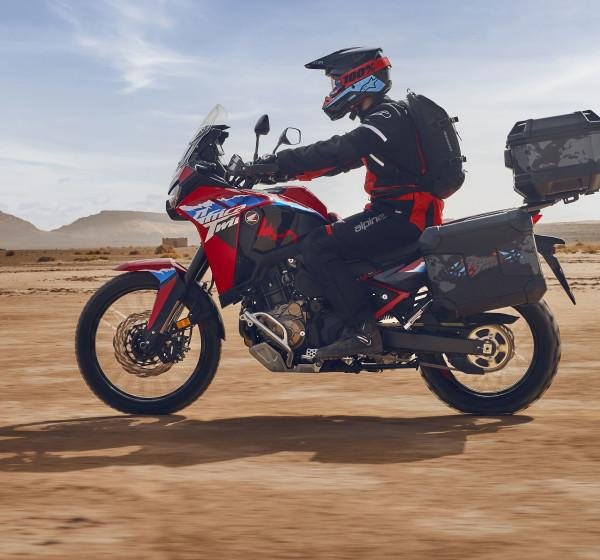
This is where the Africa Twin begins to make sense.
Despite being a 1000 cc adventure motorcycle weighing more than 200 kg, it feels surprisingly manageable once underway.
Honda did a particularly good job with mass centralization, rider positioning and the narrow shape of the motorcycle around the seat and fuel tank.
The result is an adventure bike that feels considerably less intimidating when standing on the footpegs than its size might suggest.
Engine Performance
With roughly 95 PS and 98 Nm of torque, the CRF1000L will not win many horsepower competitions against modern 1200–1300 cc adventure motorcycles.
That was never really the point.
The Africa Twin engine is designed around usable performance rather than maximum output.
Power arrives progressively, giving the rider good control on:
- Gravel
- Loose climbs
- Rocky tracks
- Sand
- Mud
- Mountain roads
- Technical low-speed terrain
The 270-degree crankshaft gives the engine plenty of character while maintaining excellent control at lower speeds.
On asphalt, there is easily enough performance for overtaking and highway touring.
However, riders coming directly from high-powered adventure bikes such as a KTM Super Adventure may find the Honda less aggressive in the upper gears, particularly when carrying luggage and a passenger.
For adventure riding, that can actually be an advantage.
Predictable power is often more useful than explosive power when traction is limited.
Honda Africa Twin Off-Road Performance
One of the biggest reasons the Africa Twin became so successful is simple:
It actually works off road.
Many large adventure motorcycles are excellent road-tourers but quickly become difficult once the surface gets loose.
The Africa Twin is different.
Its combination of a 21-inch front wheel, 18-inch rear wheel, substantial ground clearance and long-travel suspension gives it a genuine advantage on rough terrain.
Standing Riding Position
The Africa Twin feels relatively narrow between the legs when the rider stands on the footpegs.
That makes it easier to:
- Move body weight forward and backward
- Control the motorcycle with the legs
- Maintain balance on loose surfaces
- Absorb bumps
- Steer using body position
The riding position feels much more natural off-road than many road-focused adventure motorcycles.
Suspension Performance
The Showa suspension is another major strength.
With approximately 230 mm of front travel and 220 mm at the rear, the Africa Twin can absorb terrain that would quickly overwhelm a more road-biased motorcycle.
Correct suspension setup remains important.
A fully loaded Africa Twin carrying luggage, fuel and camping equipment requires additional preload and potentially damping adjustments.
Set up correctly, however, the suspension handles:
- Washboard tracks
- Potholes
- Rocky surfaces
- Erosion channels
- Desert pistes
- Moderate jumps
- Fast gravel roads
very well for a motorcycle in this weight category.
Is the Honda Africa Twin Good in Sand?

Yes—but rider experience matters enormously.
A 230+ kg motorcycle will never behave like a 110 kg enduro motorcycle in deep sand.
Momentum, body position, tire choice and throttle control become extremely important.
The Africa Twin’s smooth engine delivery and 21-inch front wheel help, but riders should still respect the motorcycle’s weight.
On harder desert tracks and compact sand, the Africa Twin can be excellent.
Deep Sahara dunes are a different environment.
For technical dune riding, a lighter enduro motorcycle such as a KTM 450 EXC-F is considerably easier to control and recover after a fall.
This is an important distinction between adventure riding and enduro riding.
The Africa Twin is designed to travel long distances while handling significant off-road sections.
A KTM 450-class enduro motorcycle is designed to attack technical terrain.
Both are capable off-road motorcycles, but they serve different purposes.
Honda Africa Twin Reliability
Search for Honda Africa Twin reliability, and you will find this is one of the motorcycle’s strongest selling points.
Honda did not push the original 998 cc engine to extreme levels of horsepower or compression.
Instead, the focus was on durability, tractable performance and mechanical simplicity.
That philosophy suits adventure travel perfectly.
If you are riding hundreds of kilometers from the nearest major city, reliability matters more than having another 20 horsepower.
Long-term touring use has shown the Africa Twin to be capable of accumulating substantial mileage when correctly serviced.
The engine, gearbox and general chassis construction have developed a strong reputation for durability.
Of course, reliable does not mean maintenance-free.
A motorcycle constantly exposed to:
- Dust
- Water crossings
- Sand
- Mud
- High temperatures
- Rough roads
will require more attention than one used exclusively for weekend road riding.
Frequent inspection remains essential.
Why the Africa Twin Engine Is So Durable
Several design choices contribute to its reputation.
Moderate Engine Tune
Honda designed the original CRF1000L engine to produce usable power rather than record-breaking horsepower.
Lower internal stress can contribute to long-term durability.
Unicam Cylinder Head
Honda’s Unicam arrangement allows a relatively compact cylinder-head design while operating four valves per cylinder.
270-Degree Crank
Beyond creating the distinctive engine character, the crankshaft configuration delivers smooth and predictable torque that works particularly well when traction is limited.
Fuel Tolerance
Adventure motorcycles frequently operate in regions where premium fuel is difficult to find.
The Africa Twin’s relatively conservative engine design makes it well suited to international travel compared with highly stressed performance engines that may be more sensitive to fuel quality.
Honda Africa Twin Gearbox
The six-speed manual gearbox is one of the strongest aspects of the motorcycle.
Shifts are smooth and precise, and the clutch is manageable both on and off road.
Honda also offered its Dual Clutch Transmission (DCT).
DCT eliminates the conventional clutch lever and allows the motorcycle to change gears automatically while still providing the rider with considerable control over gear selection.
Opinions remain divided among off-road riders.
Traditional riders may prefer a manual clutch for maximum control during technical riding.
Others appreciate DCT because it eliminates the possibility of stalling and reduces workload during long days.
For touring, especially where the route includes large amounts of asphalt and easy dirt roads, DCT can be exceptionally comfortable.
Honda Africa Twin Electronics
By today’s standards, the electronics on early CRF1000L models look relatively straightforward.
That simplicity is not necessarily a disadvantage.
Depending on year and specification, equipment includes:
- ABS
- Switchable rear ABS
- Honda Selectable Torque Control
- Multiple traction-control settings
- DCT riding modes on automatic versions
Being able to disable rear-wheel ABS is particularly useful off-road.
On loose terrain, riders sometimes need the rear wheel to lock slightly in order to control direction and braking distance.
Traction control can also be adjusted depending on the surface and rider preference.
Honda Africa Twin Comfort and Touring Ability
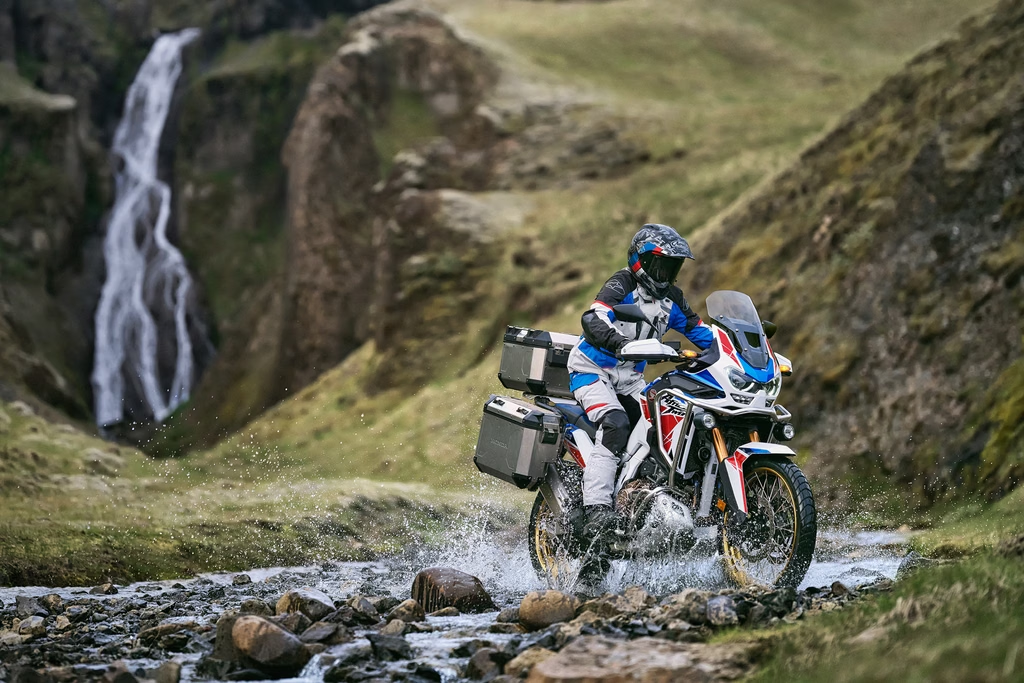
Adventure motorcycles have to perform two very different jobs.
They must work off-road while remaining comfortable enough to cover hundreds of kilometers in a day.
The Africa Twin strikes that balance particularly well.
The riding position is upright and natural, with enough room for long days in the saddle.
Wind protection is respectable, although taller riders may choose an aftermarket windscreen.
The 18.8-liter fuel tank also gives the motorcycle useful touring range without making the bike unnecessarily wide.
For long-distance travel, the Africa Twin works well with:
- Panniers
- Soft luggage
- Top boxes
- Tank bags
- Navigation equipment
- Engine protection
- Auxiliary lighting
Just remember that every accessory adds weight.
A lightly equipped adventure motorcycle is almost always easier to handle off-road than one overloaded with unnecessary equipment.
Honda Africa Twin Problems: What Should You Watch For?
No motorcycle is perfect.
Although the CRF1000L has an excellent overall reputation, there are several issues worth checking when buying a used Africa Twin.
1. Fork Seal Wear
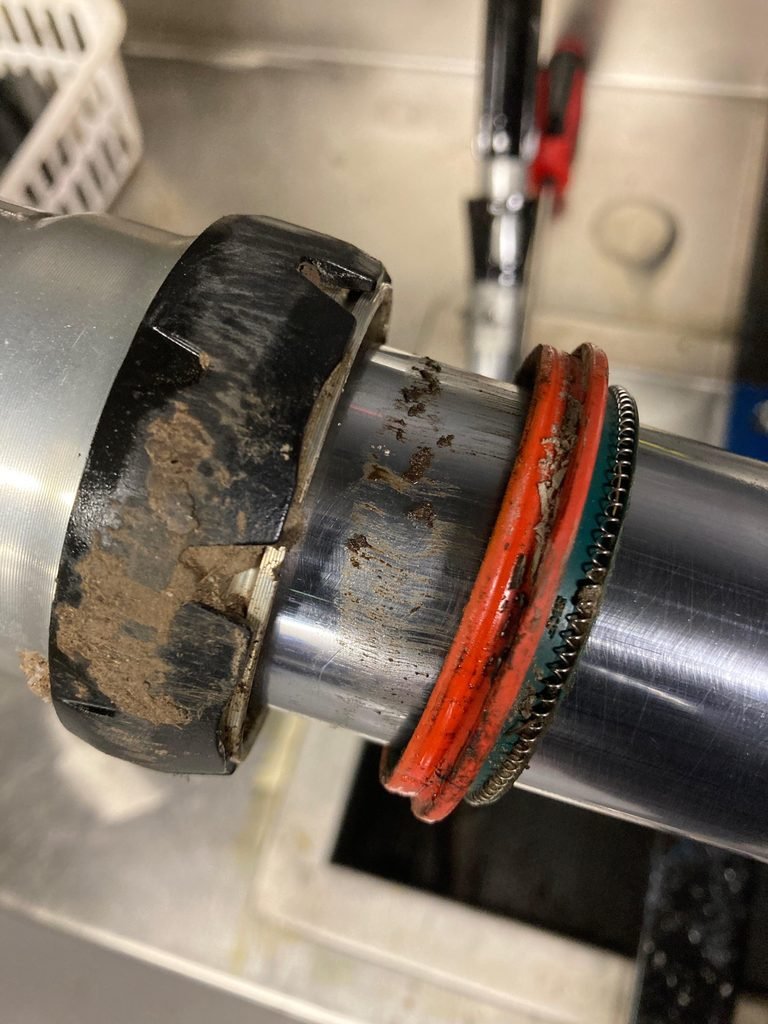
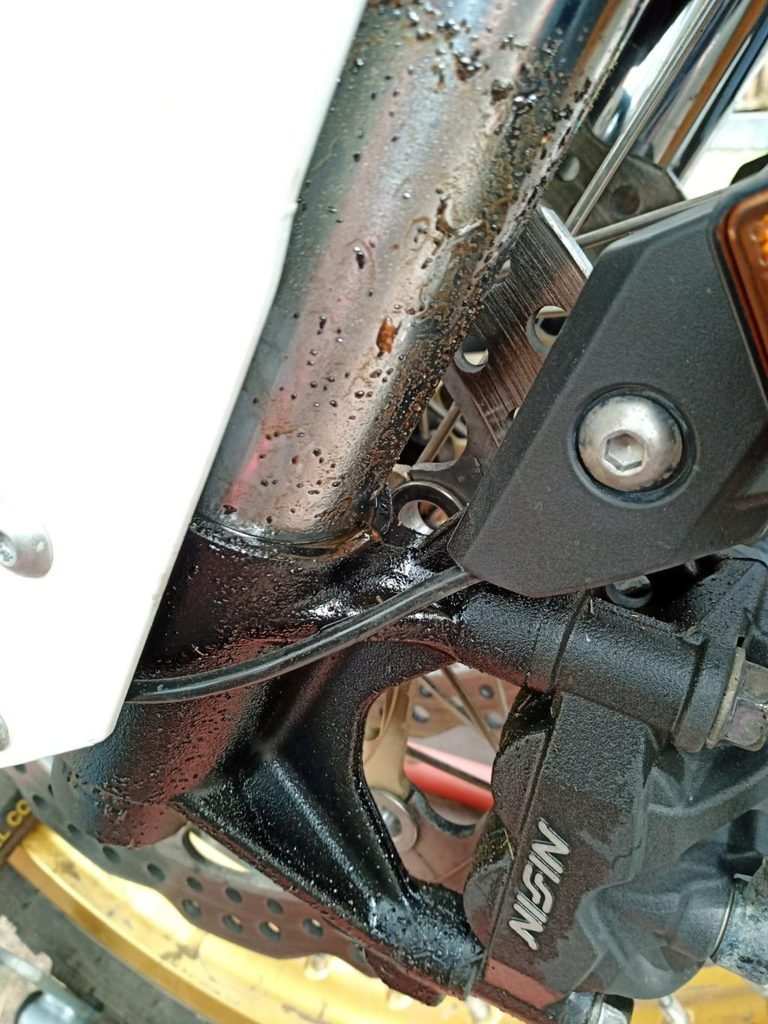
Early Africa Twins developed a reputation among some owners for premature fork-seal leakage, particularly motorcycles frequently used in dirt, mud and dusty environments.
The fork tubes and seals should therefore be inspected carefully.
Look for:
- Oil around the fork seals
- Dirt trapped around the seal
- Damage to the fork tubes
- Abnormal front-suspension movement
Keeping fork tubes clean after dusty rides can help extend seal life.
Neoprene fork protectors may also reduce the amount of contamination reaching the seals, although they should themselves be cleaned regularly.
2. Adventure Sports Fuel-Filter Recall
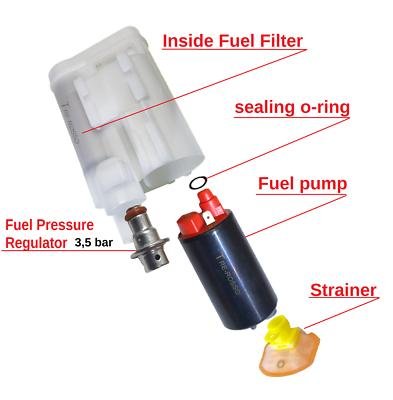
This is particularly important when shopping for an Africa Twin Adventure Sports.
Certain 2018–2019 Adventure Sports motorcycles were subject to a safety recall related to contamination inside the fuel tank.
Contamination could restrict the fuel filter and potentially cause hesitation or engine stalling.
Anyone considering one of these motorcycles should check the VIN with an authorized Honda dealer or the relevant national recall database to confirm whether the required work has been completed.
Do not simply assume an older motorcycle has already received the repair.
3. Rear Subframe Design
The original Africa Twin uses a frame design where damage around the rear structure can be more involved to repair than on motorcycles with an easily removable bolt-on subframe.
This does not mean the frame is weak.
However, anyone planning aggressive off-road riding should install sensible protection and avoid carrying excessive luggage on the rear of the bike.
When buying used, inspect carefully for evidence of major crashes.
4. Loose Rear Fasteners and Tail Section
Regular off-road vibration can loosen components.
Pay particular attention to:
- Rear rack fasteners
- Grab handles
- Number-plate bracket
- Tail-light assembly
- Luggage mounting points
Applying the correct torque and inspecting fasteners periodically is simple preventive maintenance.
5. Weight
Technically, this is not a mechanical problem.
But it is one of the biggest disadvantages of the Africa Twin.
A 230+ kg adventure motorcycle can feel remarkably agile while moving but extremely heavy when stationary or lying on its side.
Riders planning serious off-road adventures should practice:
- Slow-speed control
- Hill starts
- Standing turns
- Emergency braking
- Motorcycle recovery techniques
- Picking the bike up safely
before heading into remote terrain.
Honda Africa Twin Pros and Cons
Excellent Reliability
The Africa Twin has established a strong reputation as a dependable long-distance motorcycle.
Genuine Off-Road Geometry
A 21-inch front wheel, 18-inch rear wheel, substantial ground clearance and long suspension travel make it far more capable off road than many road-focused adventure bikes.
Smooth Power Delivery
The engine produces enough power for serious touring without becoming difficult to control on loose surfaces.
Comfortable Riding Position
Whether sitting or standing, the ergonomics work well for adventure riding.
Strong Suspension
The Showa suspension performs well across a broad range of surfaces when correctly adjusted.
Manual and DCT Options
Honda gives riders two very different but equally interesting transmission choices.
Excellent All-Round Ability
Few motorcycles combine commuting, touring and off-road exploration as naturally.
Disadvantages
Heavy in Technical Terrain
More than 230 kg is a lot of motorcycle when riding slowly through rocks or deep sand.
Less Powerful Than Some Competitors
Riders chasing maximum acceleration may prefer higher-output European alternatives.
Early Fork-Seal Concerns
Hard off-road use can accelerate seal wear.
Adventure Sports Fuel-System Recall
Potential buyers should confirm that recall work was completed where applicable.
Crash Damage Can Become Expensive
Large adventure motorcycles have expensive bodywork and components, making good crash protection worthwhile.
Honda Africa Twin vs KTM Adventure Bikes
The Honda and KTM approach adventure riding differently.
KTM traditionally emphasizes performance, aggressive handling and powerful engines.
Honda generally takes a more balanced approach, prioritizing predictable performance, usability and durability.
For aggressive riders who want maximum engine performance and sporting character, a KTM Adventure may be more exciting.
For travelers who prioritize long-distance reliability, controllable power and straightforward ownership, the Africa Twin has obvious advantages.
Neither philosophy is inherently better.
The right motorcycle depends on where and how you ride.
Honda Africa Twin vs KTM 450 EXC-F
This comparison is particularly important for riders considering an off-road motorcycle trip in Morocco.
Although both motorcycles can travel off road, they are completely different machines.
| Honda Africa Twin | KTM 450 EXC-F |
|---|---|
| Adventure motorcycle | Enduro motorcycle |
| Around 230+ kg | Around half the weight |
| Built for long-distance travel | Built for technical off-road riding |
| Comfortable on highway | Limited long-distance road comfort |
| Carries luggage easily | Minimal luggage capacity |
| Good on dirt roads | Exceptional in technical terrain |
| Manageable sand performance | Excellent in sand and dunes |
| Better for mixed touring | Better for pure enduro |
If your goal is riding from Europe through Morocco while exploring pistes along the way, the Africa Twin makes sense.
If your goal is attacking Sahara dunes, rocky trails, dry riverbeds and technical desert tracks for six or seven hours per day, a KTM 450 EXC-F is the more suitable tool.
Is a Used Honda Africa Twin Worth Buying in 2026?
Absolutely worth considering.
The arrival of newer adventure motorcycles has not suddenly made the CRF1000L obsolete.
The original Africa Twin already had the fundamentals right:
- Reliable engine
- Excellent chassis
- Proper adventure wheel sizes
- Long suspension travel
- Comfortable ergonomics
- Useful electronics
- Strong parts availability
- Proven long-distance capability
Newer Africa Twins use Honda’s larger 1084 cc engine and offer more sophisticated electronics, but that does not mean every rider needs the latest version.
In fact, some adventure travelers may specifically prefer the relative simplicity of the first-generation CRF1000L.
A properly maintained 2016–2018 example can still be an excellent motorcycle for:
- Long-distance travel
- European touring
- Morocco motorcycle trips
- Gravel roads
- Desert pistes
- Commuting
- Two-up touring
- Overland travel
Condition matters more than age alone.
What to Check Before Buying a Used Honda Africa Twin
Before buying a used CRF1000L, inspect the motorcycle carefully.
Check the Service History
A complete maintenance history is preferable, especially on high-mileage motorcycles.
Inspect the Fork Seals
Look for oil or dirt buildup around the seals.
Check the Wheels
Inspect the spokes and rims for damage caused by hard off-road impacts.
Inspect the Chain and Sprockets
Adventure riding can be particularly hard on final-drive components.
Look Under the Motorcycle
Damage to the skid plate, engine cases and exhaust can reveal how aggressively the motorcycle has been ridden.
Inspect Crash Bars and Bodywork
Scratches are normal on an adventure bike, but badly bent protection may indicate a significant crash.
Check the Steering Bearings
Heavy motorcycles ridden on rough terrain can put substantial loads through steering-head bearings.
Test the Electronics
Confirm that ABS, traction control, dashboard and riding modes operate correctly.
Check Recall Status
Adventure Sports buyers should confirm that all applicable recall work has been completed.
Inspect Luggage Mounts
Look for cracks, bent mounting points or signs the motorcycle has been severely overloaded.
Is the Honda Africa Twin Good for Beginners?
It depends on what kind of beginner.
The Africa Twin has a friendly engine and predictable handling, but it is still a tall, heavy and powerful motorcycle.
Someone with road-riding experience who is new to adventure riding can learn on an Africa Twin with appropriate instruction.
A complete motorcycle beginner will usually progress faster on something lighter.
The same applies off road.
Learning sand riding on a 230 kg Africa Twin is considerably harder than learning the same techniques on a lightweight enduro motorcycle.
Developing correct technique on a lighter machine first can dramatically improve confidence when returning to a large ADV.
Is the Honda Africa Twin Good for Morocco?
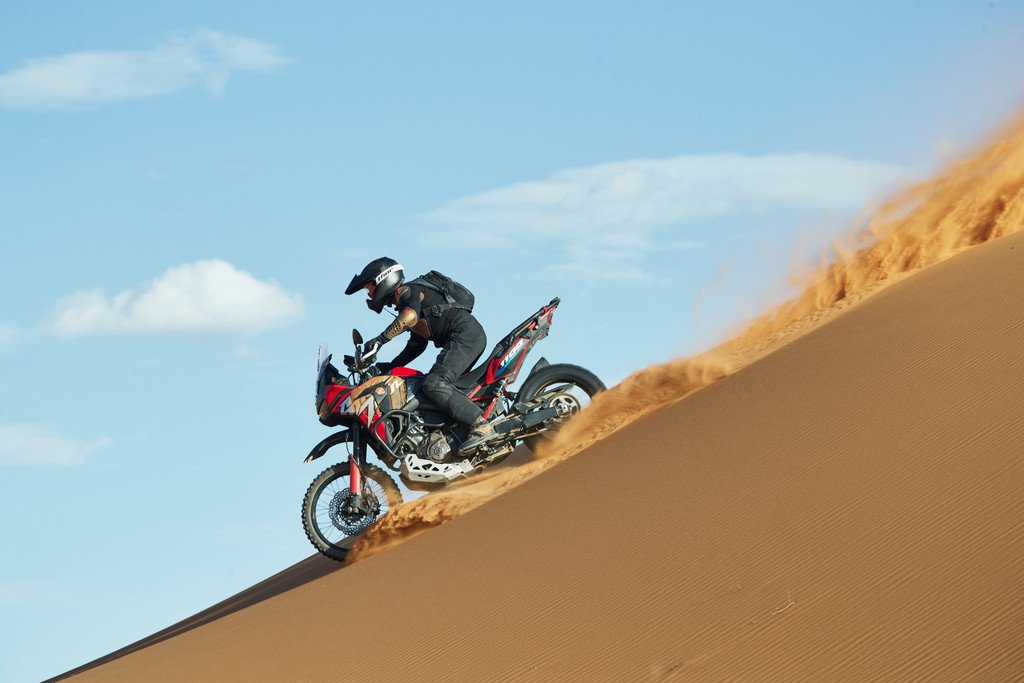
Yes.
Morocco is almost perfectly suited to adventure motorcycles.
A typical journey can combine:
- Mountain passes
- High-speed asphalt
- Gravel roads
- Remote villages
- Rocky pistes
- Desert tracks
- Dry riverbeds
- Long open landscapes
An Africa Twin allows a rider to cover significant distances comfortably while still exploring away from paved roads.
However, route selection is important.
Morocco also contains extremely technical terrain and deep dunes where a lighter enduro motorcycle is much more appropriate.
Adventure bikes and enduro bikes can both deliver unforgettable experiences in Morocco—they simply create different types of adventure.
Honda Africa Twin Maintenance for Adventure Riding
If you regularly ride off road, maintenance intervals should not be treated as the only time to inspect your motorcycle.
After particularly dusty or difficult trips, pay attention to:
- Air filter
- Chain tension and lubrication
- Brake pads
- Wheel spokes
- Fork seals
- Wheel bearings
- Steering-head bearings
- Engine protection
- Luggage mounts
- Radiator
- Tires
- Fasteners
Dust deserves special attention.
An adventure motorcycle operating repeatedly in desert environments should have its air-filtration system checked more frequently than one used primarily on clean roads.
Preventive maintenance is always cheaper than repairing a motorcycle in the middle of nowhere.
Who Should Buy a Honda Africa Twin?
The Africa Twin is particularly well suited to riders who want one motorcycle capable of doing many jobs.
Consider an Africa Twin if you want to:
- Travel internationally
- Explore dirt roads
- Carry luggage
- Ride comfortably for several hours
- Commute during the week
- Travel two-up
- Explore Morocco or similar destinations
- Own a motorcycle with strong long-term reliability
- Prioritize controllable performance over extreme horsepower
Look elsewhere if your priority is:
- Lightweight technical enduro
- Extreme dune riding
- Maximum road horsepower
- Sport-bike acceleration
- Very low seat height
- Minimal motorcycle weight
Honda Africa Twin Review: Final Verdict
Few adventure motorcycles have balanced road comfort, off-road capability and reliability as successfully as the Honda Africa Twin.
The CRF1000L did not need record-breaking horsepower to become successful.
Honda concentrated on the characteristics that matter once an adventure becomes more than a Sunday ride: controllable torque, useful suspension travel, sensible ergonomics, real off-road geometry and dependable engineering.
There are weaknesses.
The motorcycle is heavy, particularly in technical terrain. Early models can experience fork-seal issues, and buyers of certain Adventure Sports versions need to verify that the fuel-system recall has been completed.
Those concerns do not fundamentally change the character of the motorcycle.
For riders looking for a dependable adventure bike that can comfortably cover a thousand kilometers of asphalt and still turn onto a remote gravel track when the road ends, the Africa Twin remains one of the strongest choices in the category.
And that may be its greatest achievement.
Years after the original CRF1000L appeared, riders are still asking whether they should buy one.
For many adventure travelers, the answer begins with the same question:
Where do you want your motorcycle to take you?
Ride Off-Road in Morocco
Already own an Africa Twin but want to experience what a dedicated enduro motorcycle can do in the Moroccan desert?
At Morocco Enduro Ride, our enduro tours take riders beyond the typical adventure-bike routes and into the terrain that Morocco is famous for—Sahara dunes, desert pistes, dry riverbeds, rocky tracks and remote landscapes.
Ride a KTM 450 EXC-F with a professional local guide and full support while discovering the Moroccan desert from a completely different perspective.
Our tours can include:
- KTM 450 EXC-F motorcycle
- Fuel
- Professional local guide
- Assistance vehicle
- Mechanic and technical support
- Accommodation
- Breakfast, lunch and dinner
- Water
- Riding equipment
- Luggage transport
- Airport transfers on selected packages
Tours are available from Merzouga, Errachidia and Ouarzazate, with routes adapted to the group’s riding level.
Frequently Asked Questions About the Honda Africa Twin
Is the Honda Africa Twin reliable?
Yes. The Africa Twin has developed an excellent reputation for engine and drivetrain reliability when correctly maintained. Its relatively conservative engine tune also makes it attractive for long-distance and international adventure travel.
How many kilometers can a Honda Africa Twin last?
There is no fixed lifespan. A correctly serviced motorcycle can cover very high mileage, while maintenance history and previous use are more important than the number on the odometer alone.
Is the Africa Twin good off road?
Yes. Its 21-inch front wheel, 18-inch rear wheel, long-travel suspension and substantial ground clearance make it one of the more off-road-capable large adventure motorcycles.
Is the Honda Africa Twin too heavy?
It depends on the terrain. On roads and flowing gravel tracks its weight is manageable, but technical trails, mud and deep sand can make a 230+ kg motorcycle demanding.
Is the Honda Africa Twin good in sand?
It can perform well in sand with an experienced rider and suitable tires, but deep sand and dunes are significantly easier on a lightweight enduro motorcycle.
What problems does the Honda Africa Twin have?
Potential areas to inspect include early-model fork seals, heavily used wheels and bearings, loose rear components and applicable fuel-filter recall work on certain Adventure Sports motorcycles.
Should I buy a manual or DCT Africa Twin?
Choose the manual if you prefer traditional clutch control, especially for technical off-road riding. DCT is excellent for riders who value convenience, smooth gear changes and reduced fatigue during long-distance touring.
Is the 2016 Honda Africa Twin still worth buying?
Yes, provided it has been maintained properly. The original CRF1000L still offers an excellent combination of reliability, comfort and off-road ability.
What is the difference between an Africa Twin and an enduro motorcycle?
The Africa Twin is a large adventure motorcycle designed for long-distance mixed-terrain travel. A dedicated enduro motorcycle such as the KTM 450 EXC-F is dramatically lighter and designed primarily for challenging off-road terrain.
Is the Africa Twin suitable for Morocco?
Yes. It is particularly well suited to Morocco’s mountain roads, gravel tracks and long desert pistes. For deep dunes and highly technical desert riding, a lighter enduro motorcycle is generally easier to manage.