

The Royal Enfield Himalayan 450 represents one of the biggest changes in the history of Royal Enfield.
For decades, many riders outside India associated Royal Enfield primarily with simple, retro-styled motorcycles. The Himalayan 450 changes that perception. Instead of relying heavily on nostalgia, Royal Enfield has produced a thoroughly modern adventure motorcycle built around a liquid-cooled engine, ride-by-wire throttle, long-travel suspension, switchable ABS and a full-colour TFT display.
More importantly, the Himalayan 450 remains relatively affordable compared with many modern adventure motorcycles.
But an adventure bike cannot be judged by its specification sheet alone. It needs to work on highways, broken roads, mountain passes, dirt tracks, sand and long-distance journeys.
So, how good is the Royal Enfield Himalayan 450 when the road disappears?
Royal Enfield: More Than a Retro Motorcycle Brand

Before getting into the Himalayan 450 itself, it is worth understanding where Royal Enfield comes from.
Royal Enfield produced its first motorcycle in 1901, and the company describes itself as the oldest motorcycle brand in continuous production. Its Indian manufacturing story began when the British company partnered with Madras Motors in 1955 to establish Enfield India.
Today, Royal Enfield is far more than a manufacturer of traditional road bikes.
The Himalayan 450 is evidence of the company’s move into a more modern generation of motorcycles while retaining the simplicity and accessibility that made Royal Enfield popular around the world.
And compared with the previous Himalayan 411, this is a major technological step forward.
A Completely Different Himalayan
Anyone familiar with the previous Royal Enfield Himalayan 411 should avoid assuming the 450 is simply a larger version of the same motorcycle.
It isn’t.
At the center of the new bike is Royal Enfield’s Sherpa 450 engine, a liquid-cooled, four-valve, DOHC single-cylinder motor.
Official specifications list displacement at 451.65cc, producing 40.02 PS at 8,000 rpm and 40 Nm of torque at 5,500 rpm. Power is delivered through a six-speed gearbox with a slip-and-assist clutch and electronic fuel injection controlled by ride-by-wire.
That makes the Himalayan 450 considerably more sophisticated than the air-cooled Himalayan 411 it replaced.
It feels like a motorcycle designed for today’s adventure market rather than an old-school motorcycle adapted for adventure use.
Royal Enfield Himalayan 450 Specifications
| Specification | Royal Enfield Himalayan 450 |
|---|---|
| Engine | Liquid-cooled single-cylinder DOHC |
| Displacement | 451.65cc |
| Maximum Power | 40.02 PS @ 8,000 rpm |
| Maximum Torque | 40 Nm @ 5,500 rpm |
| Gearbox | 6-speed |
| Fuel System | Electronic fuel injection |
| Throttle | Ride-by-wire |
| Frame | Steel twin-spar tubular frame |
| Front Suspension | 43 mm USD fork |
| Front Travel | 200 mm |
| Rear Suspension | Linkage monoshock |
| Rear Travel | 200 mm |
| Ground Clearance | 230 mm |
| Standard Seat Height | 825–845 mm adjustable |
| Kerb Weight | 196 kg |
| Fuel Capacity | 17 litres |
| Front Wheel | 21 inch |
| Rear Wheel | 17 inch |
| ABS | Dual-channel, switchable |
| Instrument Display | 4-inch TFT with connectivity/navigation |
These figures show exactly where the Himalayan sits.
This is not a lightweight enduro motorcycle pretending to be an adventure bike. It is a genuine middleweight adventure motorcycle designed to cover substantial distances while still handling rough terrain.
Sherpa 450 Engine: The Biggest Improvement
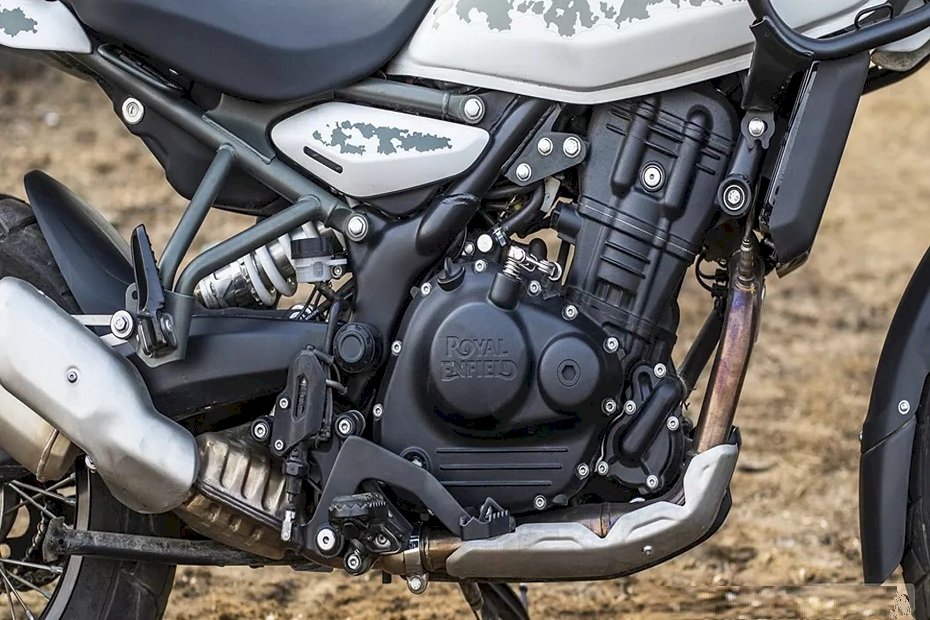
The engine is arguably the most important change.
Royal Enfield’s previous Himalayan was admired for simplicity, but riders wanting stronger highway and off-road performance could quickly discover its limitations.
The Sherpa 450 is very different.
With approximately 40 PS available, the new bike has enough performance for highway riding, overtaking and fast open tracks without losing the manageable power delivery that adventure riders often prefer.
It isn’t designed to deliver the explosive acceleration of a competition-derived 450 enduro motorcycle.
That’s important.
Comparing the Himalayan directly with something such as a KTM 450 EXC-F or Honda CRF450RL misses the point. Those motorcycles have much stronger off-road and competition influences.
The Himalayan was conceived as an adventure motorcycle from the beginning.
Its job is to carry a rider and luggage hundreds of kilometers, tackle rough roads and remote trails, and still remain comfortable enough to do it again the next morning.
For that job, the Sherpa engine makes sense.
Impressive Fuel Injection at High Altitude
One particularly demanding test of the Himalayan 450 took place in Nepal, where the motorcycles travelled through dramatically changing elevations.
The route ranged from approximately 2,600 feet to around 15,500 feet above sea level.
Naturally, any normally aspirated motorcycle loses performance as altitude increases because less oxygen is available. What matters is how well the fuel-injection system compensates.
The Himalayan continued running cleanly, starting easily and delivering predictable power despite the dramatic elevation changes.
That’s exactly what riders need from an adventure motorcycle.
When you’re hundreds of kilometres from a workshop, smooth fueling and predictable starting behavior matter far more than an impressive dyno figure.
Highway and Open-Track Performance
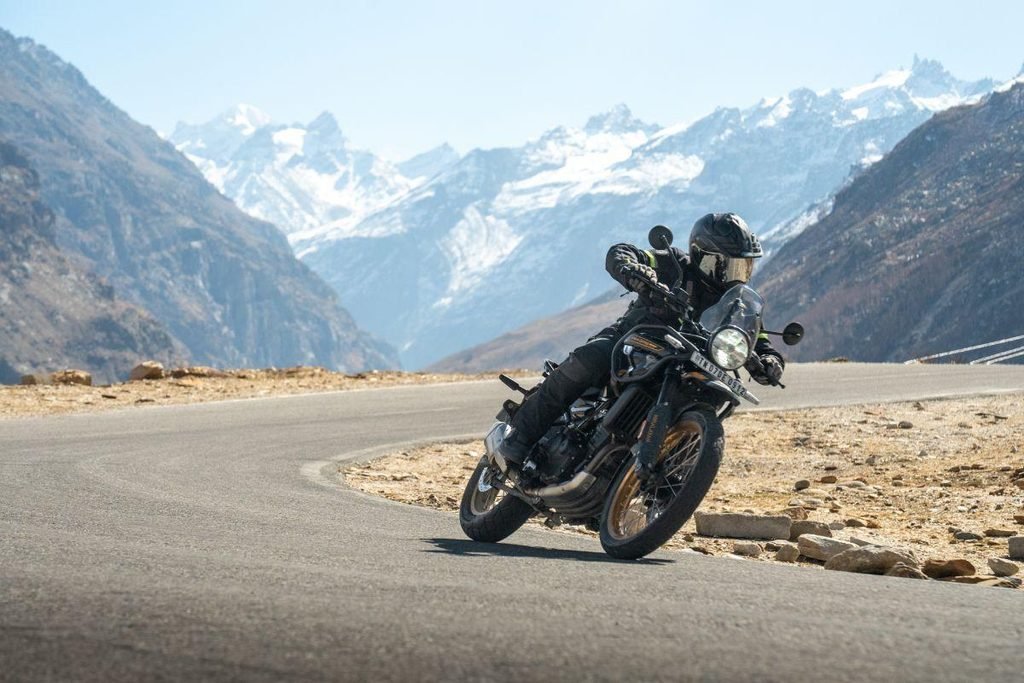
Once elevation dropped and more power became available, the Himalayan demonstrated that the Sherpa engine isn’t merely designed for slow exploration.
It can maintain serious speeds on open terrain.
But outright top speed isn’t where this motorcycle makes its strongest argument.
The important improvement is that the Himalayan 450 now has enough performance to make longer highway journeys considerably easier.
You can ride paved roads to reach your destination, spend the day exploring unpaved tracks, and then comfortably cover another long stretch of tarmac afterward.
That versatility is fundamental to a good adventure bike.
Himalayan 450 Off-Road Performance
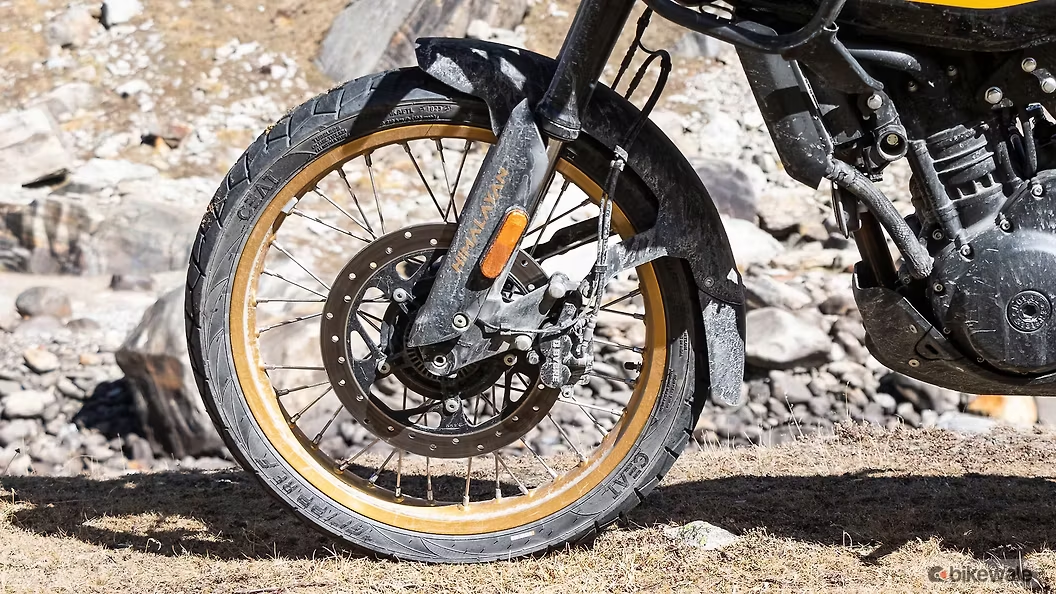
Move away from paved roads and the Himalayan begins revealing why Royal Enfield equipped it with a 21-inch front wheel, 17-inch rear wheel, 230 mm ground clearance and 200 mm of suspension travel at both ends.
The Showa suspension is intentionally compliant.
An adventure motorcycle needs to absorb rocks, potholes, corrugations and unpredictable surfaces without exhausting its rider.
The Himalayan handles that type of terrain particularly well.
The wide handlebars provide useful leverage while riding standing up, while the relatively narrow area around the seat and fuel tank allows the rider to move around the motorcycle more naturally off-road.
The riding position also feels genuinely designed around adventure use rather than being an ordinary street-bike layout with taller suspension.
The Suspension Is One of the Highlights
Adventure motorcycle suspension requires compromise.
Make it too firm and the bike becomes tiring during long rides over broken roads.
Make it too soft and aggressive riders can quickly reach the limits of the suspension.
Royal Enfield has leaned toward comfort.
For most Himalayan buyers, that is probably the right decision.
The 43 mm inverted front fork provides 200 mm of travel, while the linkage-type rear monoshock offers the same 200 mm.
The suspension absorbs rough terrain effectively and contributes significantly to the motorcycle’s comfort during long-distance riding.
Riders attempting to treat the Himalayan like a lightweight enduro bike will eventually find its limits.
Adventure riders exploring trails, mountain roads and desert tracks are much closer to its intended use.
Comfort Matters on an Adventure Motorcycle
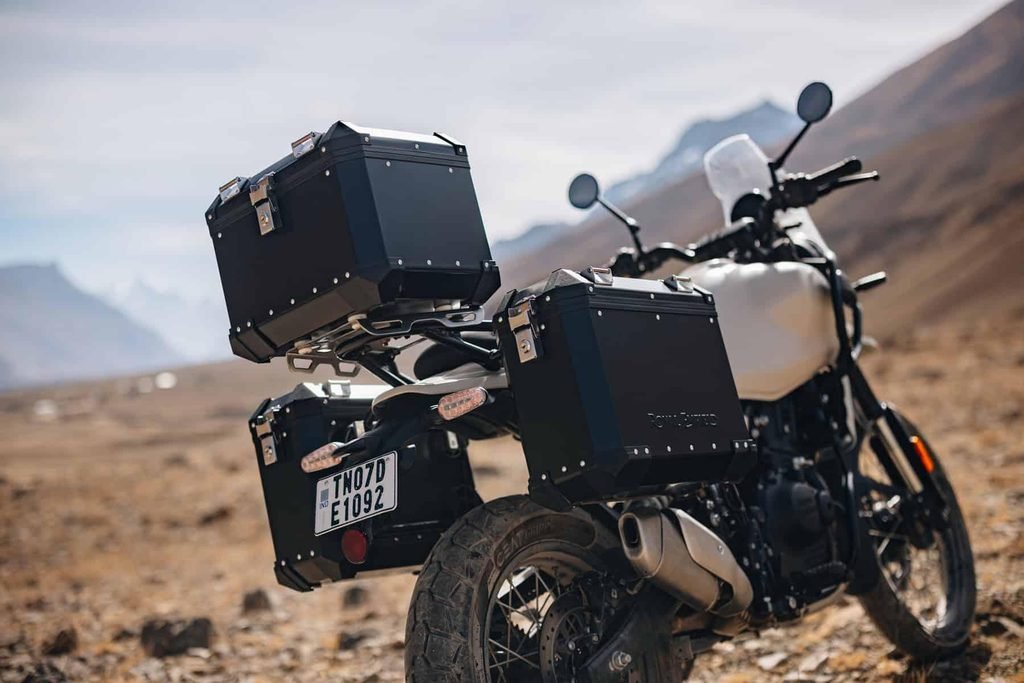
One area where lightweight enduro bikes struggle against motorcycles such as the Himalayan is long-distance comfort.
The Himalayan is designed for hours in the saddle.
Royal Enfield uses an adjustable two-piece seat with a standard height ranging from 825 mm to 845 mm. An optional lower seat can reduce that further to approximately 805 mm.
That adjustability makes the motorcycle more accessible to riders of different heights.
There is also a windscreen, substantial fuel capacity and a riding position that works both seated and standing.
These details might seem less exciting than horsepower figures, but after six or seven hours of riding, they become considerably more important.
The Biggest Disadvantage: Weight
There is one specification you can’t ignore.
196 kg kerb weight.
That is more than 430 pounds.
Royal Enfield quotes a dry weight of 181 kg and approximately 196 kg with 90 percent fuel and oil.
That weight is noticeable when terrain becomes technical.
On flowing gravel roads and open tracks, it provides stability.
When the trail becomes steep, sandy, rocky or narrow, however, those kilograms become increasingly difficult to hide.
Picking the motorcycle up after a fall is also very different from lifting a 110- or 120-kilogram enduro motorcycle.
This is probably the most important distinction for potential buyers.
The Himalayan 450 can certainly ride off-road.
But it remains an adventure bike, not an enduro bike.
17-Litre Fuel Tank Makes Sense for Adventure Riding
Adventure motorcycles need range.
The Himalayan carries 17 litres of fuel, or roughly 4.5 U.S. gallons. Royal Enfield’s published European technical data lists consumption at approximately 3.59 L/100 km, although actual fuel economy will naturally vary according to riding style, terrain, luggage, speed and conditions.
A larger tank becomes especially valuable in regions where fuel stations are separated by long distances.
For riders exploring remote mountain routes or desert landscapes, range isn’t just convenient—it can determine where you are able to ride.
Technology Without Going Too Far
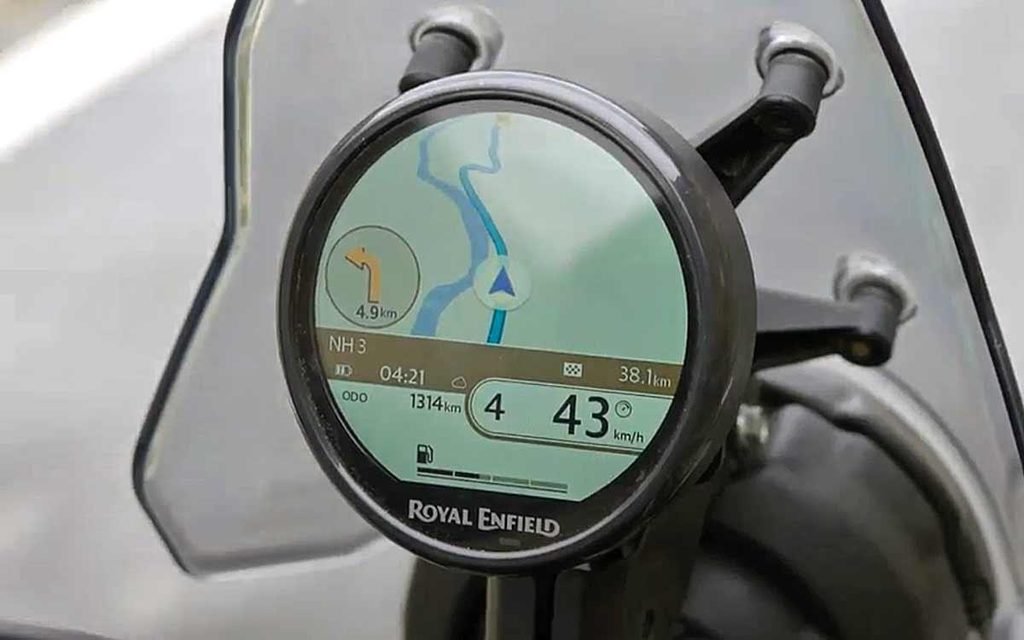
Modern adventure motorcycles can sometimes feel overloaded with electronic systems.
Royal Enfield has kept things relatively straightforward while still giving the Himalayan useful technology.
The bike includes ride-by-wire, selectable riding modes, switchable dual-channel ABS, LED lighting, a USB-C charging connection and a 4-inch TFT instrument display with smartphone connectivity and Google Maps-powered navigation functionality.
That combination fits the personality of the motorcycle well.
There is enough technology to make adventure travel easier without turning the cockpit into something that requires studying a manual every time conditions change.
What About Reliability?
Reliability is understandably an important consideration when buying an adventure motorcycle.
The more remote the journey, the more important it becomes.
One useful real-world test involved a group of 17 Himalayan 450 motorcycles being ridden repeatedly through difficult Himalayan terrain.
The bikes experienced the normal crashes and abuse expected during an adventure ride, yet no significant mechanical failures were reported. Damage was largely limited to minor crash-related components such as levers.
That doesn’t prove what every Himalayan will look like after 50,000 or 100,000 kilometres.
Long-term reliability can only be demonstrated through long-term ownership.
But seeing a fleet of motorcycles survive repeated days of demanding terrain is certainly encouraging.
Himalayan 450 vs Himalayan 411
The jump from the Himalayan 411 to the Himalayan 450 is substantial.
The earlier motorcycle used a 411cc air-cooled single-cylinder engine producing much less power and paired with a five-speed transmission.
The 450 introduces liquid cooling, DOHC architecture, four valves, a six-speed gearbox, ride-by-wire and approximately 40 PS.
The chassis, electronics, suspension and overall performance philosophy have also moved forward.
Anyone who dismissed the Himalayan after riding the 411 should consider riding the 450 before making the same judgment.
They are very different motorcycles.
Himalayan 450 vs Lightweight Enduro Bikes
Adventure riders occasionally compare the Himalayan with motorcycles such as the KTM 450 EXC-F.
The comparison is understandable because both motorcycles can ride off-road, but they serve different purposes.
A lightweight enduro motorcycle prioritizes technical off-road performance, low weight, aggressive suspension and maneuverability.
The Himalayan prioritizes range, stability, comfort, luggage capability, road performance and manageable off-road ability.
If your typical ride involves extremely technical singletrack, deep sand, large jumps or hard enduro terrain, the Himalayan isn’t the obvious tool.
If your journey involves 200 km of road followed by mountain tracks, villages, river crossings and another highway ride the following day, its design suddenly makes much more sense.
How Much Does the Royal Enfield Himalayan 450 Cost?
Price has been one of the Himalayan’s strongest selling points.
Early U.S. versions started around $5,799, but buyers should check the current model year rather than relying on the original launch price.
Royal Enfield’s current U.S. listings show pricing varying according to year, color and specification. For example, the company’s 2027 listings show Kaza Brown at $5,999 MSRP, while higher-spec versions cost more. Destination charges, taxes, registration and accessories are additional.
That remains an important part of the Himalayan’s appeal.
You get a modern adventure platform without immediately entering the price territory occupied by many premium European adventure motorcycles.
Who Is the Royal Enfield Himalayan 450 For?
The Himalayan makes the most sense for riders who want one motorcycle capable of doing many different jobs.
It can commute.
It can tour.
It can travel long distances.
It can carry luggage.
It can explore dirt roads.
It can tackle rocky tracks and mountain passes.
And it can take you considerably farther off the pavement than an ordinary road motorcycle.
Riders focused mainly on competition-level off-road performance should look toward lighter enduro machinery.
Riders interested in exploration may find the Himalayan’s compromises much easier to appreciate.
Royal Enfield Himalayan 450: Pros and Cons
The strongest points are the modern Sherpa 450 engine, comfortable suspension, excellent adventure ergonomics, 17-litre fuel capacity, 21-inch front wheel, strong value, modern electronics and impressive versatility.
The biggest compromise is weight. At roughly 196 kg ready to ride, technical off-road terrain requires considerably more effort than it would on a lightweight enduro motorcycle. Riders looking for aggressive competition-style performance may also want more power and firmer suspension.
For its intended purpose, however, those aren’t necessarily design failures. They’re the result of building a motorcycle capable of carrying fuel, luggage and a rider over long distances.
Final Verdict: Has Royal Enfield Built a Serious Adventure Bike?
The Himalayan 450 feels like an important motorcycle for Royal Enfield.
It moves the Himalayan name away from the limitations of the previous 411 and into genuine modern adventure-bike territory.
The Sherpa 450 motor provides enough performance for real touring. The Showa suspension works well across rough terrain. The 21-inch front wheel, 230 mm ground clearance and standing riding position give it legitimate off-road capability.
It is comfortable enough for full days of riding, carries a useful amount of fuel and offers electronics that genuinely help without overwhelming the rider.
Yes, it’s heavy.
And no, it isn’t going to replace a KTM EXC-F when trails become seriously technical.
But that’s not what the Himalayan 450 was built to do.
It was built to travel.
Road today. Gravel tomorrow. Mountain tracks the next day.
And possibly no road at all after that.
For riders who value adventure, range, simplicity and versatility more than outright racing performance, the Royal Enfield Himalayan 450 has become a much more serious option than the Himalayan name has ever been before.
Frequently Asked Questions About the Royal Enfield Himalayan 450
Is the Royal Enfield Himalayan 450 good for off-road riding?
Yes. Its 21-inch front wheel, 200 mm front and rear suspension travel, 230 mm ground clearance, standing-friendly ergonomics and switchable ABS make it capable on gravel, rocky tracks and moderate off-road terrain. Its 196 kg kerb weight becomes a disadvantage on more technical trails.
How much horsepower does the Himalayan 450 have?
The Sherpa 450 engine produces 40.02 PS at 8,000 rpm with 40 Nm of torque at 5,500 rpm.
What is the engine size of the Himalayan 450?
The Royal Enfield Himalayan 450 uses a 451.65cc liquid-cooled, single-cylinder DOHC engine with four valves and electronic fuel injection.
How heavy is the Royal Enfield Himalayan 450?
Royal Enfield lists a dry weight of 181 kg and a kerb weight of approximately 196 kg with 90 percent fuel and oil.
What is the fuel capacity?
The Himalayan 450 has a 17-litre fuel tank, making it well suited to longer adventure rides.
Is the Himalayan 450 suitable for beginners?
Its predictable single-cylinder engine, comfortable riding position and relatively accessible seat height can make it manageable for riders moving into adventure motorcycling. However, beginners should remember that a motorcycle weighing almost 200 kg becomes challenging when dropped or ridden through deep sand and technical terrain.
Is the Himalayan 450 better than an enduro motorcycle?
Neither type is universally better. They serve different purposes. The Himalayan is better suited to long-distance adventure travel, luggage and mixed road/off-road journeys, while a lightweight enduro motorcycle is far easier to manage on technical off-road terrain.
From the Himalayas to the Moroccan Desert
The Royal Enfield Himalayan 450 proves how much fun exploring beyond paved roads can be. But riders who want to experience a more focused off-road motorcycle adventure can take things a step further.
At Morocco Enduro Ride, we organize guided enduro adventures through Morocco using KTM enduro motorcycles, taking riders across Sahara dunes, desert tracks, dry riverbeds, remote villages and spectacular mountain landscapes.
Whether your idea of adventure is crossing the Himalayas on an ADV bike or attacking the Moroccan desert on a lightweight enduro motorcycle, the important part is the same:
Get out there and ride.